I’ve had my share of ‘bombshell’ moments, where a health professional has said something that changed the path of my life. At first, I didn’t want to talk to anyone. But I couldn’t stay muted for ever. This is the first of two articles about those difficult conversations we all need to have in times of crisis.
It’s a tricky moment, bumping into somebody outside the doctor’s surgery.
“Hello John, how are you?”
“All right, you?”
“Yeah fine, well – er – not that fine [points to the building] but, yeah, fine, thanks.”
At that moment I was about as far from feeling fine as the North Pole is from the South. My doctor had just dropped the P-word and I was struggling to take it in. Hence the white lie (sorry, John) – the truth would have been far more complicated.
I don’t remember much about the consultation, except the doctor giving the thumbs-up to exercise and to activities that reduce anxiety. There was no time to process the information. I didn’t know what questions to ask so I probably asked some dumb ones. All I knew is that I wasn’t the same person coming out as I had been going in. I got into the car and wondered if I was even allowed to drive it.
Bombshell moments
Why don’t I remember? Why didn’t I ask sensible questions?

Sue Jackson is a coach who specialises in helping people to feel empowered to navigate change and uncertainty in their work and lives. She’s worked with many people with cancer and other long-term medical conditions. She says:
“There’s a physiological response to bad news that releases the stress hormones cortisol and adrenaline. These reduce the activity of the prefrontal cortex – the part of the brain that’s involved in emotional control, decision making and problem solving. More primitive parts of the brain take over which generate your natural flight, fight, freeze response. You either want to run away or defend yourself, or you just sit staring into space like a rabbit in headlights.”
Rehearsing difficult conversations
My first instinct was to crawl away and hide under the duvet. My head was full of half-rehearsed conversations and to-do-lists, which kept me awake. Like Eric Morecambe’s concert pianist, I was playing all the right notes, but not in the right order.
I needed someone outside my immediate circle to help me set my priorities and rehearse what I was going to say to people. I wish I’d known Sue at the time because this is something she excels at. She says:
“Coaching offers a neutral confidential space where you can express fears and vulnerabilities that you don’t feel able to share with your family, friends and colleagues. It helps you work out what you want to do – when and who to ask for help.”
Ironing out the crumples
Imagine a jacket crumpled on the floor. First the coach provides the hanger to get it off the floor, then the iron to get it pressed, then it’s ready for you to wear. The jacket hasn’t changed shape, but you feel more confident wearing it.
Now think about your ‘content’ – all the things you want to say – as that crumpled jacket, and how you are going to get it pressed and on to the hanger ready to wear. In part 2, Sue and I will look at ways of picking up, pressing and practising those difficult conversations with the people in your life.
Empowerment
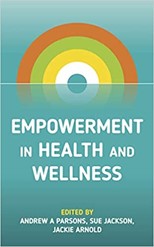
Sue Jackson is the co-editor, with Andrew Parsons and Jackie Arnold, of Empowerment in Health and Wellness (Panoma Press, 2021). The book is a huge resource of ideas and proven ways to enable people to take control of their own health and professionals to support their clients in times of illness, stress and loss, when being empowered allows us to navigate uncertainty more competently. The book is valuable for workplaces too, particularly to support employees’ mental health.
Play> Do you want to know a secret? > Billy J Kramer and the Dakotas
Lots of sixties bands were named [front man] + the [backing], for example Billy J Kramer and the Dakotas, Wayne Fontana and the Mindbenders. What was your favourite band name? And if you were naming a band this way today, what would you call it? I quite fancy ‘Macrihanish and the Gauldrons’ after a walk we did in Scotland last year.


2 Comments
Sue King · 24 May 2021 at 8:56 am
I can’t vouch for the book as I haven’t read it but what you say about the state of mind of someone who has just been given devastating news rings very true. Looking forward to part two of this blog post.
Local hero (wild theme) - ParkyTracks · 26 May 2021 at 10:08 am
[…] my last blog Do you want to know a secret? I spoke with coach Sue Jackson about the difficult conversations we all need to have in times of […]