I’m always searching for new, fun ways to create that ‘magic hour’ in which I forget I have Parkinson’s. Last week was no exception as I set foot into the world of West African drumming.
I’ve been drumming a lot lately – my wonderful team at Neuro Heroes have introduced a drumming routine to the fitness section of my twice-weekly PD Power session. Big, powerful movements, no special instruments required – it’s amazing how high I can raise my heart rate simply by beating up the sofa cushions with a fish slice in each hand.
Wooden Roots
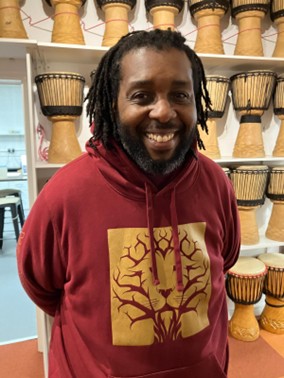
Wooden Roots drum maestro Marcus Brown
Last week, seeking something a little more sophisticated than kitchen utensils, I jumped at the chance to attend a West African drumming workshop. Marcus Brown’s twin passions are building traditional West African drums and teaching people how to play them. He and his wife Gemma have brought together a lively and supportive community in East Suffolk. They started Wooden Roots in 2007 in a tiny apartment in California. Now, in spacious premises on the site of a former US airbase, Marcus crafts and sells drums, there’s a shop and a big classroom, where you can make as much noise as you like without disturbing the neighbours. It all looks rather grey and unpromising from the outside, but inside is a refreshing burst of colour.
Marcus, Gemma and their team run a variety of events at the base as well as visiting schools and community groups. Their monthly Creative Health Workshop is tailored for people with Parkinson’s and other neurological conditions – carers and family members are particularly welcome to join in.
About the drums
Before we could start making a joyful sound, Marcus talked us through the drums we were to play. Djembe are goblet-shaped wooden drums with goatskin drumheads attached and tuned by rope. They are played with the hands. Different positions on the drumhead make different sounds, and no two instruments are exactly the same. They have their origins in West Africa – the word Djembe means ‘everyone gather together in peace’.
Dununs are larger cylindrical drums, also with skin drumheads, that can be played either on their side or on end. They provide a rhythmic bass line to the djembe. They are played with sticks, and there’s also a metal cowbell that’s hit with a metal rod. (think opening bars of Honky Tonk Woman.)
I made a beeline for the biggest of these drums (the Dununba) which came with a dual tasking challenge of remembering which beat was the drum, which the bell and which both together. I didn’t always get it right, but you know me – I love to have a go!
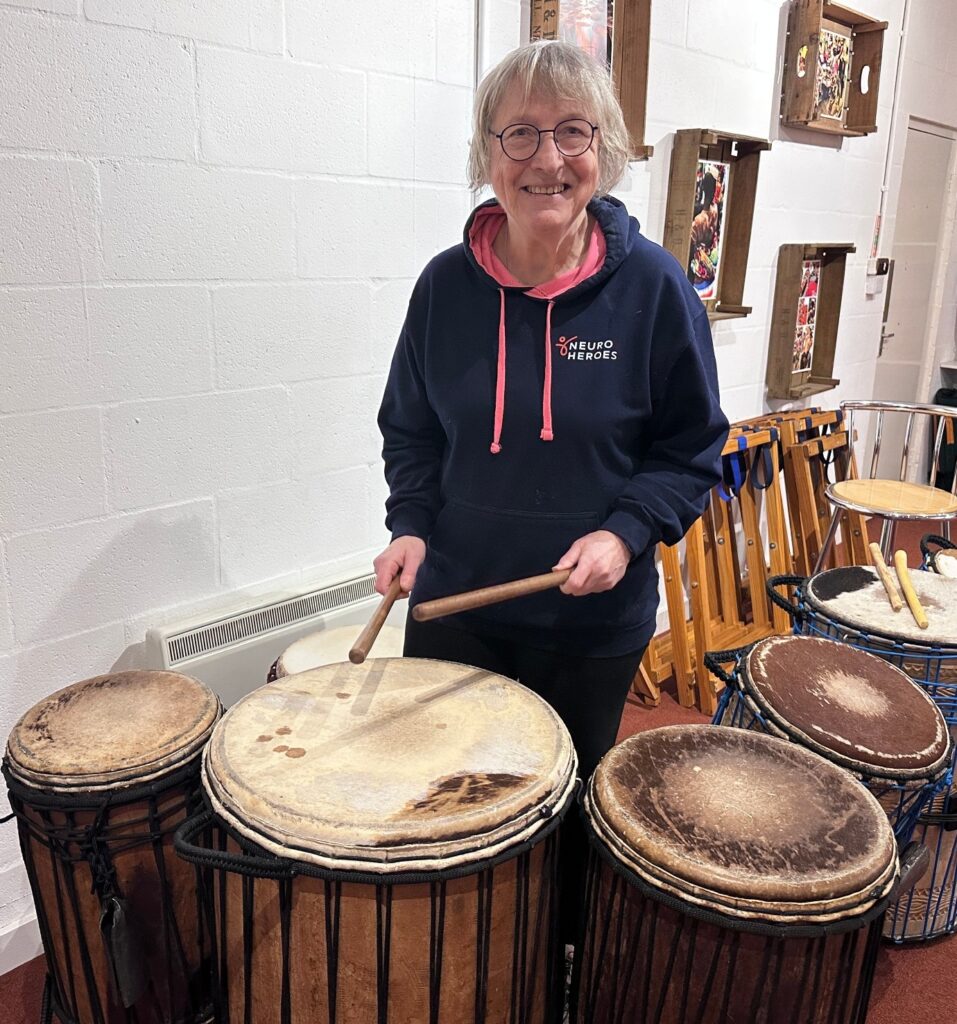
Ali has a go
Teamwork
Our group worked together on a traditional rhythm called a Sorsonet. This is a rhythm from the Baga people of the coastal region of Guinea in West Africa. Sorsonet is also the name of a mask that brings good luck and protects against evil. Traditionally, priests keep the mask safely hidden in the forest, bringing it out for special occasions.
I got rhythm
Drumming helps those of us with Parkinson’s regain our sense of rhythm. Early on in my Parkinson’s life (I got rhythm, July 2021) I discovered how external musical cues could help me move more smoothly, with no shuffling or freezing. The brass band marches of Sousa helped me even up my lop-sided gait and persuade my left leg to come out and play. I started to make bigger strides and swing my arms more. Big movements helped to big up my tiny handwriting and ease out stiffness and pain.
In a small-scale study, a research team in Pennsylvania found that:
“Drum circle classes significantly and reversibly improved quality of life in patients with PD”
They called for larger, controlled investigations to develop this theme further.
In Elgin, Scotland, Jo Holland, who has Parkinson’s, has teamed up with activity instructor Sharon Finlay to deliver Parkinson’s Beats. This is an award-winning cardio drumming exercise programme. Participants drum an exercise ball with sticks to music, and report improvements to both motor and non-motor symptoms. You can join in on Zoom from anywhere.
Magic hour
Marcus’ workshop ticked my usual box of making me forget, while taking part, that I have Parkinson’s at all. I certainly wasn’t the only one in the room. It was a joyous social occasion and I’m grateful to Christine Bullen and her husband Len Roux for making it possible. Christine has recently joined the ranks of Parkinson’s volunteers in east Suffolk and launched Off-Beat Activity. It’s a group for people with Parkinson’s who feel that their ideal support group hasn’t quite formed yet.
Christine is busy rustling up a menu of fun taster activities in East Suffolk. Our next adventure is scaling an indoor climbing wall; other ideas she’s working on include steampunk morris dancing, escape rooms and zip wire. Suggestions welcome, the wackier the better.
Play > This practice video (not of our group) shows you how the drums sound together in a Sorsonet.

1 Comment
Christine Bullen · 30 March 2026 at 8:33 am
Great blog Ali