I’m the expert in Me and my Parkinson’s. But I’d still like to find out more. So I’m delighted to find out about a champion of personal science, who encourages us to be both researcher and subject.
Wise old Owl. Bear of Very Little Brain. Who’s the clever one?
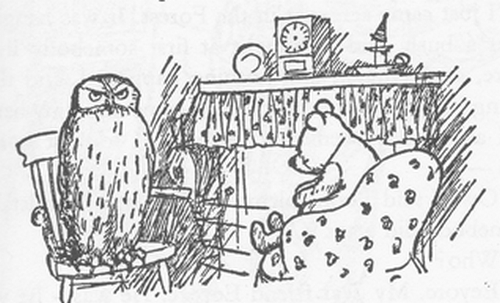
In AA Milne’s Winnie-the-Pooh, Pooh consults Owl on the sad matter of Eeyore’s missing tail.
“Well,” said Owl, “The customary procedure in such cases is as follows.”
“What does Crustimoney Proseedcake mean?” said Pooh. “For I am a Bear of Very Little Brain, and long words Bother me.”
“It means the Thing to Do.”
“As long as it means that, I don’t mind,” said Pooh humbly.
I think Pooh is the clever one. First, he’s not afraid to take advice. Then, he’s not afraid to ask more questions if he doesn’t understand.
I’ve met many grey old Owls who fluff up their feathers and try to impress me with long words.
For example, this week I read that:
“Acidic nanoparticles can re-acidify lysosomes, increasing α-synuclein degradation via enhancing lysosomal activity (in vitro & in vivo) ameliorating α-synuclein pathology in mice.”
Now I’ve no doubt this is ground-breaking stuff in the Parkinson’s scientific community. I might prick up my little furry ears if I was a mouse and you put a plate of yummy acidic nanoparticles in front of me. But where lab research on rodents is concerned, I am the little boy in the crowd for whom the King is still very much in the altogether. It will be a long time before these results can be relevant for me and my Parky friends. Then, given my luck, I would be the statistical outlier on the scattergram for whom the intervention proved inappropriate.
All about me
I want research that focuses on me – where I set the hypothesis, design the interventions, analyse and apply the results straight away. For example, do I run the Parkrun better with an extra half-Sinemet 20 minutes before the start? (Answer: Yes) If the results are good, I’ll want to share them for the benefit of others.
I’d need to up my game, because I’m lazy. Parkinson’s symptoms are so unpredictable, there is no pattern to them. Or is there? Up till now I’ve had a real carpe diem approach to my condition, and I rarely log anything useful. Just sometimes it might be handy to reflect on the days I seized yesterday and the day before, or even this time last year.
I have a GPS watch, and a smartphone. I know how to enter stuff on Excel. I have pen and paper. Mostly I keep stuff in my head. I ask myself questions but I never document the answers. Could I use the technology better to monitor my own activities – distance run, timing of meds, hours of sleep, ‘off’ and ‘on’ time?
Introducing personal science
Sara Riggare has done just that, and this week she was awarded her PhD from Radboud University in Nijmegen, The Netherlands. In her thesis Personal Science in Parkinson’s Disease – a patient-led research study she is both researcher and subject, setting herself questions and answering them by measuring and self-tracking. As she is quick to point out, she spends an hour a year with her neurologist and 8765 hours in self-care. Who’s the expert here?

Born in Sweden, Sara was diagnosed with Parkinson’s in 2003 when she was 32, although she had experienced symptoms since her teens. She has become a leading and respected patient advocate with a passion for patient-led research and personal science.
Sara wanted to combine her engineering training with her patient experience and improve things for herself and other people with chronic diseases. She began her research in her native Sweden, carrying out two single subject studies (N-of-1) on herself.
In the first she used a smartphone app called Fast Fingers to measure how many times she could tap the screen in 30 seconds. Tapping tests can be a useful tool for assessing motor function. She did this several times a day and recorded the results alongside a diary of her daily medication. The results helped her identify peaks and troughs that she could then present to her consultant and be more precise about the timing of her meds.
In the second study, she examined the effects of nicotine (given via e-cigarette) on a condition called levodopa-induced-dyskinesia (LID). LID is an unfortunate side-effect of taking the very medication that makes many of us feel human again. Two out of five of the e-cigs did not contain nicotine – she didn’t know which – and the results were very clear. With nicotine she felt a sense of calm spread through her body, brain fog lifted, less dyskinesia. With placebo there was no effect.
It wasn’t all about Sara – she wanted to know how other people self track and monitor their symptoms. From a survey of 180 people with Parkinson’s she concluded that:
“The main identified benefits of self-tracking gives persons with PD a deeper understanding of their own specific manifestations of PD and contributes to more effective decision-making regarding their own self care.”
The most interesting finding was the tools the respondents used – 49% used a tech device like smartphone or watch, 56% pen and paper and 74% (count me in here!) kept track in their heads.
Cinderella – you shall go to the ball
It hasn’t been easy for Sara to promote her message of personal science and self-tracking. She began her PhD in Sweden, but when the time came to submit her thesis she hit a brick wall. One senior academic said:
“But Sara, why would patients want to do research on themselves anyway? Wouldn’t it be better if you all just give your data to a proper researcher?”
Her application to defend her PhD thesis was turned down by the Karolinska Institute.
Enter Bas Bloem, professor of neurology at Radboud University. He and his colleagues could see the potential for Sara’s work, and they invited her to defend her thesis at Radboud. Which she did, successfully, last Friday.
Bas Bloem describes Sara’s thesis as:
“Inspirational work that places people living with Parkinson’s at the helm, alongside and in close collaboration with the medical team.”
Sara concludes:
“I hope that we, the community of persons living with PD, together with healthcare professionals, scientists and other people around us, jointly can develop new ways to keep living a good life with PD.”
I think it’s time to get that stuff out of my head and down on paper, don’t you? Now where did I leave that pencil?
Play > Me myself I > Joan Armatrading



2 Comments
AngiejJacobs · 28 March 2022 at 9:24 am
Good idea Ali. I know my neurologist says the medication in SA is out of the ark. ( A recent graduate I think.) but I definitely feel better on the replacement tablets which are marked on the container as Carbilev 25/250 tabs and I have to take them 3 times a day.
Christine Lindop · 28 March 2022 at 1:57 pm
Sometimes the best ideas are the simplest ones. Good for her for persevering. As ever, real food for thought.