“How long have you had Parkinson’s?” It’s a question I’m often asked, and there is always more than one answer.
I’ve been diagnosed and managing my condition since the summer of 2019, but I’m not the only person with Parkinson’s to realise, with 20/20 hindsight, that it all started years before that. Our dopamine lights don’t suddenly switch off without warning. They are on a dimmer switch.
Always keen to try new activities, in 2015 I enrolled on a British Rowing Learn to Row course at Talkin Tarn in Cumbria. I loved the people, and I loved being on the water in the sunshine. But it was all such a slog! It was a team effort to get the boat out of the boathouse and into the water, and I didn’t feel strong enough to contribute. With stiff legs and hips, I couldn’t step into or out of the boat gracefully and had to sit on the jetty and shuffle my bottom in sideways. I finished up covered in bruises.
Patiently my coach shouted instructions which went into my ears but then entered that area of my brain I now recognise as a faulty signal box. The message took an age to reach my arms and legs. With quadruple sculls I had two oars to manage, and I rarely hit the sweet spot of left and right catching the water at the same time. I knew what I was meant to be doing and occasionally felt the joy of gliding through the water at the end of a successful drive. But I was usually a split second behind the other three in my crew. Frustrating for them, frustrating for me. Sometimes the coach would repeat the instruction, hoping that this would speed things up. It didn’t – I was still processing the first message, so it was back to square one every time. I stopped enjoying myself, so I stopped going.
Other signs
I recently asked my friends if they’d noticed anything pre-2019. Sally remembers asking me if my ankle was OK because I appeared to be limping down the street. Liz says: “When we went to Edinburgh [2016] you were struggling to keep up along the Royal Mile which given your running experience at the time was strange! Also we went for a meal and your plate-to-mouth speed was noticeably very slow and considered.”
Tracey says: “I think the Edinburgh trip was when I remember noticing that your voice had become quieter, because I did wonder if it was my ears.”
I’d driven Janet to a networking event because it was ‘my turn’. On the return journey I crunched noisily through the gears and struggled to dip my headlights for oncoming drivers. Janet says: “I didn’t notice at the time, but as soon as you were Parky-approved it was your softer voice and more deliberation in moving that made me think ‘oh yes, I did see that’.”
My husband Robin has no doubt about the point when he first noticed. On a summer fell walk, we were descending by a woodland path with odd sticky-out rocks and tree roots. It shouldn’t have been difficult, but I slowed down to almost a halt. I couldn’t even walk back along the road to the car. I assumed it was some kind of glycaemic crash after a rather nice picnic baguette. I didn’t feel tired, I was in no pain, I. Just. Couldn’t. Move.
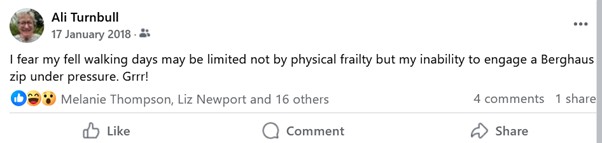
Our daughter Rosie also recalls, as Liz did, that I had started to eat r e a l l y slowly. Once I’d been a real gobbler – when you have two big brothers it’s a survival of the fittest! Then, for Rosie it was “Zips, and eventually shuffly feet”. I noticed zips all by myself on Facebook in January 2018: I apologise to Berghaus for suggesting that this might have been their fault.
Rightie says Go, Leftie says NO!
Ah, yes, those shuffly feet. As my parkrun times dipped, I had the sensation that my right leg was perfectly happy to get up on a Saturday morning to run 5k but that my left leg was much keener on staying in bed. When I could persuade it out, it scuffed angrily on the ground like a naughty toddler. I put this asymmetry and drag down to ageing and just didn’t go out running as much. I didn’t think to investigate, until my sharp-eyed sports physiotherapist spotted something and referred me to my GP.
No big picture
I don’t blame any of my family and friends for saying nothing. Little pieces of the jigsaw were locking together around the edges, but there was no big, clear picture. What would I say to someone else? I’ve really no idea.
Next time I’ll look at some diagnostic procedures emerging from the research and ask: Would I have wanted to know sooner? Is there a ‘right time’ to find out? When would you want/have wanted to know? Please join in.
Image by Gerd Altmann from Pixabay



0 Comments